
A recent breakthrough in DNA testing for genealogy is a new form of autosomal DNA testing.
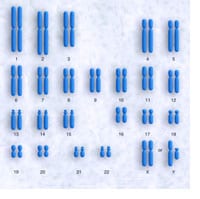
This type of test checks your autosomal chromosomes, the other 22 pairs beyond the sex-linked X and Y chromosomes.
In addition to finding genealogical matches, this new test type will also provide an estimate of your overall ethnic ancestry.
These tests are incredibly powerful, yet all three companies offering the test have slashed prices to less than $100. Follow these links to learn more about each test directly from the labs:
NOTE: My links to other sites open in new windows. If they don’t work, check your popup blocker.
Find Family across All Your Lines
Both men and women can take this type of test. Compared to Y-DNA and mtDNA tests, it is broader but shallower.
By broader, I mean that it can find matches in ANY branch of your family tree. It is not limited to just the narrow paternal or maternal lines.
Great for about Five Generations
By shallower, I mean that this new autosomal DNA test only works when people share relatively recent ancestors. Relationships out to the second cousin level are virtually certain to show up.
The chance of finding a match with a particular relative begins to decline slightly with third cousins.
It can still detect many of your relatives at the fourth and fifth cousin levels and occasionally beyond that.
The companies that provide these tests set their matching thresholds to achieve a middle ground between missing too many distant relatives and finding too many false positives.
You just need to understand that the most distant matches that you get may be speculative.
Many people don’t have good paper trails out more than a few generations anyway. So the practical test depth is ideal for peeking behind the brick walls where a lot of us are stuck.
How Genealogists Use Autosomal DNA Testing
Count out five generations to your great-great-great grandparents. You have 32 of them and most of the 16 couples probably had several children. Most of those children eventually married and had several more children and so on.
Imagine those sixteen families all multiplying and branching out for five successive generations. You could easily have thousands of living cousins in parallel branches you know nothing about.
An autosomal DNA test can introduce you to those cousins who have taken the same test. Some of your newfound cousins will have genealogical information that you lack. By comparing notes and pooling your resources, you both win.
Genealogists also use this test to confirm suspected connections between deceased ancestors. For example, if you want to be sure that two men were brothers, you can test a great-grandchild of each man to see if they have the expected second cousin relationship.
Like all forms of genetic genealogy, having good paper trails will help you make sense of your DNA information. Yet even adoptees are using the test to get clues about their birth families and ethnic background.
How It Works
The DNA you inherited from your parents is a mixture of the DNA they inherited from each of their parents. The mixing occurs randomly. But long blocks of DNA tend to stick together, often for several generations.
This new type of autosomal DNA test checks about 700,000 pairs of locations in your autosomal DNA. These locations are called single nucleotide polymorphisms (SNPs). The lab then compares your autosomal DNA with that of other customers and looks for identical segments with many common SNPs.
Often, the segments are identical because you share a common ancestor. Some short matching segments may just be coincidental. But a statistical analysis can tell the difference and predict the degree of relatedness. The more segments you share and the greater the length of those segments, the more closely related you are.
Who Do You Test?
You can, of course, test yourself. But if your parents are living and you can afford two tests, I recommend that you test both of them instead of yourself. I suggest that for the following two reasons:
1. By using a test subject that is one generation older, you will probably get more useful matches. That’s because the identical segments tend to break down further with each generation and some of the more distant cousins will go undetected.
For example, someone who is a 4th cousin to you is closer to a 3rd cousin to your parent and would be more likely to show up as a match for your parent.
2. If you test yourself, you will get matches from both sides of your family. For more distant cousins it can be difficult or impossible to tell which side a given match is from. If you test your parents separately, however, you can more confidently place unique matches on one side of your family. That allows you to focus your paper trail comparisons on the correct side and eliminate half the work.
NOTE: If both parents came from the same close-knit community or ethnic group, you may find people who share common ancestors with both of them.
Companies Offering the Test
The three companies that offer this new form of autosomal DNA testing are Family Tree DNA, 23andMe, and Ancestry.com.
Family Tree DNA offers a large variety of DNA tests for genealogists and this specific test is called Family Finder.
The two similar tests are 23andMe and AncestryDNA. Now that each test can be purchased for less than $100, adoptees and serious genealogists are ordering all three tests so they can get into all the mostly unique databases and maximize their results.
Follow my links to learn more about each test directly from the companies themselves.
I was a Beta tester with each company and have found good matches through all of them. The three companies use similar technologies to read your DNA.
Each company has its own proprietary algorithm for evaluating matches and calculating probable relationships. This can lead to different interpretations of distant relationships.
The key point is that each company does a commendable job of providing precision results. Any of them can be used reliably for relationship testing of close relatives. It’s the more distant relatives that may show up on one and not appear as a match on the other.
As far as I can tell, no one test is inherently more accurate. They’re simply a little different.
NOTE: I especially recommend that adoptees order all three tests, because fishing in multiple ponds is far more likely to produce a close match.
Ethnic Ancestry Reports
Each test includes an estimate of your overrall ethnic ancestry. You will probably get about the same basic breakout from any of them, i.e. your percentages of European, African, or Asian ancestry.
Where they differ is their breakout of subregions, e.g. within Europe and Africa.
For a much more exhaustive comparison of these autosomal DNA testing products see my Autosomal DNA Comparison page.
To take full advantage of all available features and find all your available matches, I suggest you seriously consider ordering a test from each company.
WARNING: Do not be mislead by companies offering autosomal DNA testing as “sibling” or “kinship” tests. Those are old-fashioned STR-based tests and are NOT the same as the much more powerful SNP-based tests discussed here.