

The earliest paternity test was a comparison of blood types. This analysis cannot provide absolute proof of fatherhood. But it can often eliminate a potential father.
Plus, you may already know each person’s type from medical records. In that case the cost is zero.
TIP: If a man was ever in military service, his type will be on his dog tags.
Even if you don’t already have this information for everyone, this approach may be less expensive than a DNA paternity test.
So you may want to identify the missing blood types before you incur the expense of a DNA paternity test.
ABO Blood Groups
Briefly, here’s how blood typing works.
There are four common values: A, B, AB, and O.
If you know the mother and child’s type, then you can use the following chart to narrow the list of possible types for the father.
Find the child’s value in yellow and the mother’s value in blue. Read down the child’s column and across the mother’s row to find the green cell where they intersect.
The letters listed in that cell are the possible ABO groups of the father.
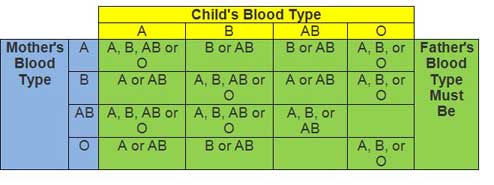
For example, if the child is A and the mother is O, the father MUST be A or AB. It is biologically impossible for a man with B or O blood to have fathered this child.
NOTE: The two blank cells represent impossible combinations between mother and child, regardless of the father.
Important Limitations of Blood Types
As you can see in the chart, there are some combinations of mother and child that show all four possibilities and cannot, therefore, eliminate any possible father.
The most important limitation is that knowing this information can, at best, only eliminate someone. By itself, it cannot prove that any given man is the child’s father.
However, if the mother knows there are only two possible candidates, eliminating one of them will tell her that the other one is the father.
If this doesn’t resolve the question—-or if you need a positive paternity test for legal purposes—-you must still get a DNA paternity test.
While many companies can provide such a test, the one I am most confident in is EasyDNA.
TIP: If your paternity issue involves child support or custody issues, you need to order their LEGAL paternity test that is court admissible. If this knowledge is just for personal information, the home test kit is sufficient.
What if the Father is Unknown?
In some cases a child’s biological father may be an unknown man. In that case DNA testing can solve the mystery, just like it has for thousands of adoptees. Read my page on Find Birth Parents to learn more.