

Many people today are curious about ethnic DNA testing. It could be yourself that you’re wondering about. Or it might be your child, a specific ancestor in your family tree, or merely the roots of your distant past.
Three DNA test types designed for genetic genealogy can now provide insights into ethnicity.
Like pieces of a jigsaw puzzle, each test makes a unique contribution to your research. Yet each test has advantages and limitations.
Which test you should use will depend on your situation and your personal goals.
Examine Your Family Tree
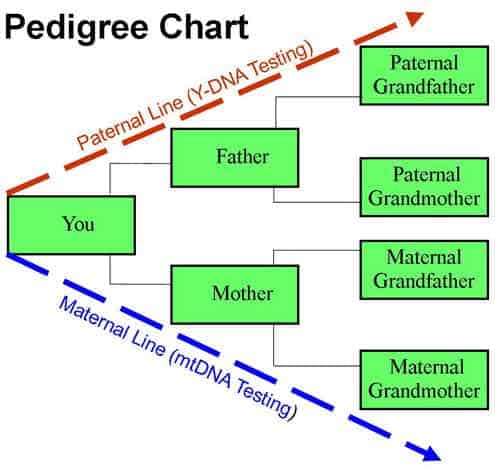
Most people know something about their parents and grandparents. Even if you don’t know all the names and dates, you can draw or imagine a family tree that looks something like the following Pedigree Chart. It starts with you at the left and goes back in time through prior generations.
ETHNIC DNA TESTING TYPE#1: Y-DNA Testing of Your Paternal Line
Your paternal line runs along the top of the Pedigree Chart through your father, his father, etc. Men pass on their Y-chromosome from right to left along this path. Over many generations, small changes occur that we call mutations. It is these mutations that begin distinct branches and let genealogists find people with recent common ancestors.
Only men have a Y-chromosome. Therefore, only men can take this test. If you’re a woman, you can still get answers about your ethnic heritage by testing a male in your paternal line, e.g. your brother, your father, your father’s brother, or a son of your father’s brother.
Y-DNA Haplogroups
The results of your test will tell you which haplotype you belong to. From that, your testing company will be able to predict your haplogroup. One company, Family Tree DNA, will automaticallly confirm your haplogroup with additional testing if needed.
[NOTE: My links to other sites open in new windows. If they don’t work, check your popup blocker.]
Your Y-DNA haplogroup indicates the ancient ancestry of your paternal line. In addition, some haplogroups are clearly associated with certain ethnic groups. For example, Y-DNA haplogroup Q3 is strictly associated with Native American populations. And Y-DNA haplogroup E3a is the most common group among African Americans.
[NOTE: Some people will get unexpected results. For example, 30% of black males in North America have a European haplogroup. That’s because many children of slaves were fathered by white men.]
Y-DNA Genetic Cousins
One of the great benefits of Y-DNA testing is the possibility of finding close genetic matches in your testing company’s database. Family Tree DNA has about 500,000 Y-DNA records in its database and the company sponsors nearly 8,000 Y-DNA surname projects. It is the only company I recommend for Y-DNA testing.
You can learn more from joining a DNA Surname Project for the last name of your male ancestors. There are also projects focused on certain ethnic groups or geographic areas.
[NOTE: I recommend at least a 37-marker test.]
If you’re trying to prove Native American ancestry, a DNA test alone may not be evidence enough for your purpose. By introducing yourself to your genetic cousins and pooling your genealogical knowledge to identify that common ancestor, you may be able to place yourself in a specific tribe.
ETHNIC DNA TESTING #2: Mitochondrial DNA Testing of Your Maternal Line
Your maternal line runs along the bottom of the Pedigree chart through your mother, her mother, etc. The test that connects people in the maternal line is mitochondrial DNA testing, often abbreviated mtDNA.
Since a mother passes on her mtDNA to ALL her children, both males and females can take this test. Once again, it’s the mutations that allow scientists to sort people into different branches of the human tree.
And once again, the market leader with the most mtDNA records is Family Tree DNA.
mtDNA Haplogroups
Your mtDNA test results will indicate your mtDNA haplogroup. This will provide a clue to the ethnicity of your maternal line.
For example, haplogroups A2, B2, C1, D1 (and sometimes X) indicate Native American ancestry. Any of the haplogroups that start with L (and some others) will indicate African ancestry.
[NOTE: Scientists chose to name both Y-DNA and mtDNA haplogroups by letters and numbers. There is some overlap in the letters. So be sure you know which type of haplogroup you and others are referring to.]
mtDNA Genetic Cousins
If you purchase an mtDNA test through Family Tree DNA, you will get a list of genetic cousins. Your matches may not be helpful for genealogy, however, since the common ancestors may have lived hundreds or even thousands of years ago.
Due to the fact that female surnames typically change every generation, finding a common ancestor can also be a lot more difficult than with Y-DNA testing.
Family Tree DNA is the only company to offer a mitochondrial Full Sequence test. This is the ultimate mtDNA test, since it checks 100% of your mitochondrial DNA. If you match someone at the full sequence level, there is a better chance that the common ancestor is a relatively recent one.
If you only want to know your base haplogroup and are not interested in matching, that information is included in the test at 23andMe.
Limitations of Y-DNA and mtDNA Testing
Y-DNA and mtDNA pass down along exclusively male and female lines. Since each is undiluted by marriage, these types of ethnic DNA testing are highly accurate. The fundamental limitation is that they only represent a small fraction of your total ethnic ancestry.
Go back just four generations and you have 16 great-great grandparents. At that point the Y-DNA and mtDNA tests each represent only 1/16 of your ethnoancestry. These types of ethnic DNA testing will totally miss the people in the center of that Pedigree Chart. Go back several more generations and you have hundreds of ancestors, each of which contributed to your personal DNA.
You May Need to Test Someone Else
You can still use Y-DNA and mtDNA tests to identify the haplogroups of others in your known family tree. You just have to clearly understand the concepts of paternal and maternal lines and find the right people to test.
For example, suppose you believe that your great grandfather was a Native American. But he was not in your direct paternal line. Just follow his paternal line forward in time through his sons and their sons to find an appropriate living male for the Y-DNA test.
If no suitable test subject is available in your great grandfather’s paternal line, consider the female lineage. Was your great grandfather’s mother a Native American? If so, follow her direct maternal line forward in time. The person you use for an mtDNA test can be male or female as long as that person’s mother is in the proper maternal line. All children have the mother’s mtDNA. But only the daughters pass it on.
ETHNIC DNA TESTING #3: Autosomal DNA Testing
Your Y-DNA came exclusively from your father down the paternal line. And your mtDNA came exclusively from your mother down the maternal line. But 22 of your 23 chromosome pairs are a mixture from both sides of your family.
Three recommended companies do ethnic DNA testing through these “autosomal” chromosomes to measure your total ancestral composition and break it down into percentage components.
Each of these tests will also include a list of genetic cousins who share significant amounts of DNA with you. The closer of your matches almost certainly share common ancestors with you.
As the volume of people doing ethnic DNA testing has gone up, prices have come down. Two of the tests are now priced at less than $100. Click the following links to learn more about each test:
The Family Finder test from Family Tree DNA includes a myOrigins ethnicity report formerly called Population Finder.
The report included with the 23andMe test is called Ancestry Composition. Since this test includes many FDA-approved reports on genetic health issues, it is priced higher than the other two.
The AncestryDNA test also includes an ethnicity estimate.
These ethnic DNA tests can detect European, African, Asian, Native American and Jewsish ancestry. As the science gets better, their reports are getting even more detailed.
For example, results once defined as Western European are now being broken down into subgroups such as English and Irish or French and German etc. Results only defined as African are starting to break down into specific countries.
Such refinements will simply appear in your report over time at no additional charge.