

In 2009 I participated in the Beta testing of Relative Finder, a new feature at 23andMe called DNA Relatives.
This innovative tool searches the 23andMe database and finds people that share enough DNA to be your relatives.
Serious genealogists are using it to learn more about their family trees.
I know it works, because I quickly found and confirmed a previously unknown third cousin.
In addition, this test provides a very robust test of close relationships.
DNA Relationship Testing
Traditional DNA kinship testing compares two people on 15-24 very specific autosomal markers.
23andMe takes an entirely different approach. Their test includes about a million autosomal markers. But they don’t compare people on individual markers. Instead, they look for very long consecutive runs of genotypes that are at least “half-identical.”
Those identical or half-identical segments can pass down from any of your ancestors, not just those in your paternal or maternal lines. And the test works equally well for men and women.
Close Relationships
If two people who suspect a close relationship take the test, Relative Finder will show them whether or not they are related. What’s more, it can distinguish degrees of close relationships such as full siblings, half siblings, and first cousins.
Such resolution among close relationships is possible because the amount of shared DNA drops dramatically as the genetic distance increases. The following table show the theoretical amount of shared DNA for some close relationships:
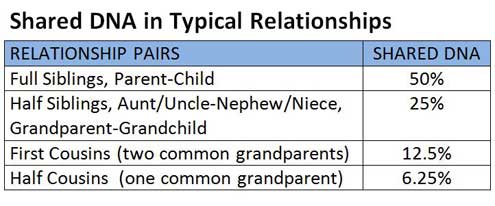
Since DNA combines randomly, actual percentages can vary considerably from the series of perfect splits implied in this table.
Note that several relationship pairs share about 25% of their DNA. Relative Finder can’t tell a half sibling pair from an uncle-nephew pair. But you usually have enough additional information to know that only one of those relationships makes sense.
Relative Finder: List View
The people you match show up in a table that you can sort in various ways. The image below shows the top records of a real table. This person tested several close relatives. The known relationships are shown here in red. In the actual report you would see people’s names.
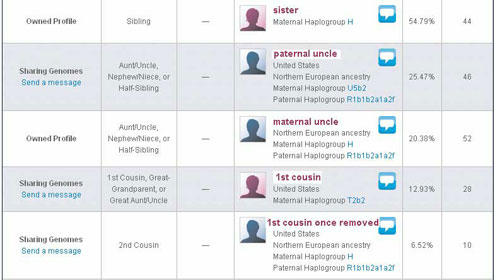
The second column shows how Relative Finder has classified the relationship. The next to the last column shows the percent of DNA you share with each person. And the far right column shows the number of DNA segments you share.
Family Inheritance View
23andMe has a Family Inheritance view where you can select two people and see the common segments on each chromosome.
The following three samples show you what to look for when you get your own test results.
Full Siblings
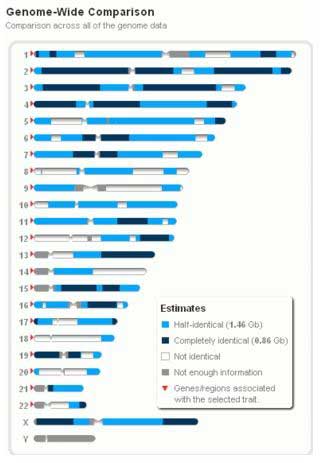
A Family Inheritance diagram for full siblings will have many large completely identical segments indicated in dark blue.
NOTE: The dark blue segments may appear as black on your monitor.
Additional “half-identical” segments are in light blue.
Sisters (like the example shown here) should show at least half-identity across the full length of the X chromosome.
Brother-brother and brother-sister pairs will typically see patches of half-identity on the X.
Half Siblings
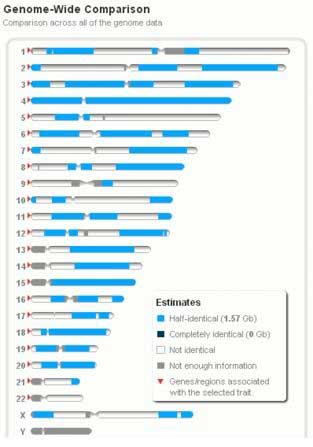
A Family Inheritance diagram for half siblings would look something like this diagram. Note that half-siblings don’t have any of the dark blue, completely identical segments.
While the test cannot tell a half-sibling relationship from one of the other 25% sharing relationships, other factors will usually dictate which relationship makes sense.
Often, the only possibilities are a close relationship or no relationship at all.
In those cases graphs like these should clearly indicate what the right answer is. And unlike traditional DNA kinship testing, even brother-sister half siblings should be obvious.
Second Cousins
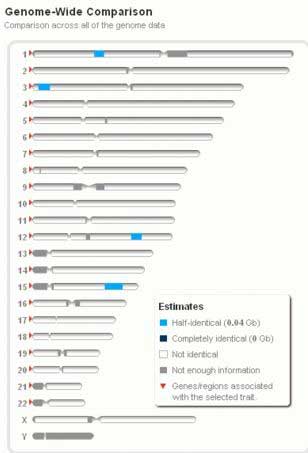
This Family Inheritance diagram compares second cousins. DNA splits and recombines with every generation. So by the time you get this far out on your family tree only a few short segments of matching DNA survive.
The projections get fuzzier as the relationship gets weaker. You can’t always tell a first cousin from a second cousin. And a projected 4th cousin might actually be anywhere from a 3rd cousin to a 10th cousin.
But I’ve seen enough to believe that Relative Finder is a great tool for getting simple Yes/No answers about the closest relationships. And that’s often all you need.
Compare Genes View
Another 23andMe view is the Compare Genes view. While that sounds like the place to look for answers, it is less useful for examining relationships.
The “percent similarity” numbers are not at all intuitive. Even unrelated people can show up in the low 70’s. Closely related people are more likely to have numbers in the 80’s. But this view does not group people into projected relationship categories like Relative Finder.
How To Order
Go to the Relative Finder web site and order the DNA test for each person. Since 23andMe is a health testing company, you will each be able to see your genetic tendency toward certain diseases.
Family Tree DNA has a a similar product called Family Finder that does Relationship Testing just as well as 23andMe’s test. The main differences? Family Finder does not include health testing. Instead, it includes report on your ethnic ancestry called Population Finder
Both 23andMe and Family Finder are more certain to provide clear answers than the traditional sibling test or kinship test. For a more detailed comparison of Relative Finder and Family Finder see my Autosomal DNA Comparison page.
I wish to thank DNA author and consultant, Ann Turner, for providing the sample screen images.